
The Yiwu Europe Railway Poland Border Closure has raised significant concern among global importers. Poland’s decision to shut down all rail crossings with Belarus on 12 September 2025 disrupted one of the primary land routes that connected Yiwu to Europe. For many businesses relying on fast freight trains from China, this move has created immediate uncertainty.
Yet it is essential to place this development in perspective. While the Yiwu-Xinjiang-Europe Railway is an important symbol of international connectivity, sea shipping still plays the dominant role in moving goods from Yiwu to the world. Trains may save time, but ships carry the overwhelming majority of containers leaving Yiwu through nearby ports such as Ningbo and Shanghai. Understanding how this closure affects rail freight, and why sea transport remains the backbone of Yiwu trade, is crucial for importers planning their supply chains.
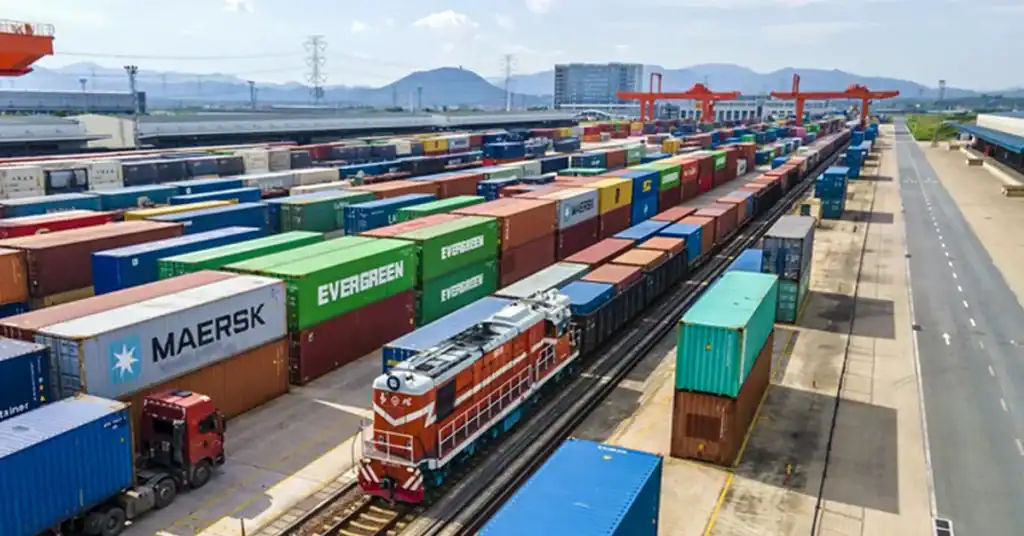
What Is the Yiwu Europe Railway?
The Yiwu-Xinjiang-Europe Railway (often abbreviated as Yiwu-Europe Railway) was launched in 2014 as part of China’s Belt and Road Initiative. It runs from Yiwu in Zhejiang Province, through Xinjiang, and across Central Asia before entering Europe. The line stretches more than 13,000 kilometers, with routes reaching destinations such as Madrid, Hamburg, and London.
Key facts about the Yiwu-Europe Railway
- Transit time: 15–20 days on average, nearly twice as fast as sea shipping.
- Main exports: consumer goods, electronics, textiles, and household products.
- Cargo share: represents only a small fraction of Yiwu’s total exports compared to sea freight.
The train gained popularity because it provided a middle option between slow sea freight and expensive air cargo. It became particularly valuable during the pandemic when global shipping lanes were congested. However, its overall scale remains modest when compared to shipping by sea.
Poland Border Closure Explained
Poland closed all border crossings with Belarus in mid-September 2025. This action was taken for national security reasons following heightened military cooperation between Belarus and Russia. The closure affects both passenger and freight rail services.
For the Yiwu-Europe Railway, this is a critical choke point. The most frequently used route passes from Belarus into Poland before continuing toward Western Europe. With the Poland-Belarus rail link cut off, freight trains from China can no longer pass through the traditional corridor that accounted for a large share of traffic.
The result is a sudden disruption to scheduled train services, leaving goods in transit stuck at border stations or forcing operators to consider longer and less efficient detours.
How the Closure Impacts Yiwu Shipments
The Yiwu Europe Railway Poland Border Closure directly affects importers who relied on rail freight for faster deliveries. Several consequences are already visible:
- Delays in delivery schedules: Cargo that would normally reach Europe in just over two weeks now faces indefinite waiting times or rerouting.
- Higher transportation costs: Alternative routes require longer distances, additional customs checks, and more fuel.
- Congestion at border hubs: Trains have backed up at Belarus terminals, creating further bottlenecks.
- Planning uncertainty: Importers cannot guarantee arrival dates, creating challenges for inventory management and order commitments.
While this disruption is serious for rail freight users, it is important to remember that the majority of Yiwu shipments travel by sea. Containers leaving Yiwu for Europe typically pass through Ningbo-Zhoushan Port or Shanghai Port, both of which remain fully operational and unaffected by the Poland-Belarus closure.
Sea Shipping Still Dominates Yiwu Trade
Despite the attention given to rail freight, sea shipping continues to account for more than 90% of Yiwu’s export volume. Ports near Yiwu have the capacity to handle millions of TEUs (twenty-foot equivalent units) every year.
Why sea freight remains essential
- Capacity: One large container ship can carry as much cargo as hundreds of freight trains.
- Reliability: Maritime trade routes are well-established, with fewer sudden closures compared to land corridors.
- Cost-effectiveness: Sea freight is significantly cheaper per unit than rail or air transport.
- Flexibility: Importers can choose between full container load (FCL) and less-than-container load (LCL) depending on order size.
For importers sourcing from Yiwu, this means that although the rail closure may slow certain shipments, the overall trade flow from Yiwu remains stable. Most buyers will continue to rely on sea shipping as their main logistics solution.
Alternative Routes for Yiwu to Europe Freight
Even with the Yiwu Europe Railway Poland Border Closure, there are other options available for rail freight, though they come with challenges:
Possible alternatives
- Baltic routes: Trains can detour through Lithuania or Latvia, though capacity is limited.
- Ukraine corridor: Riskier due to ongoing instability but technically feasible for certain goods.
- Southern routes: Some trains may bypass Belarus by traveling through Kazakhstan, then toward Turkey and Eastern Europe.
Multi-modal solutions
- Rail + Sea: Cargo can be sent by train to Chinese ports, then shipped by sea to Europe.
- Rail + Road: Containers can transfer onto trucks at border bottlenecks, though this raises costs.
Given the uncertainties of rerouting, many importers will conclude that sticking with traditional sea shipping remains the most practical choice.
Yiwu-Europe Railway in Perspective with Sea Shipping Statistics
| Statistic | Value & Source | What It Shows |
| China-Europe Railway TEU Volume from Yiwu in 2024 | Yiwu’s China-Europe Railway Express is estimated to run ~1,300 trips in 2024, moving over 140,000 TEUs, up by nearly 10,000 TEUs vs 2023. | Shows moderate growth of rail freight from Yiwu despite challenges. Supports claim that rail’s role is growing but still limited in scale. |
| Eurasian Rail Route Total TEUs 2024 | ~745,900 TEUs traveled along Eurasian rail routes in 2024, up 10.6% from 674,000 in 2023. | Demonstrates overall rail freight growth in China-Europe routes, though still small compared to sea freight volumes. |
| China → EU Rail Freight Growth in 2024 | Volumes from China to EU rose by ~130.8% in 2024 to ~330,704 TEUs. Conversely, EU→China shipments dropped by ~26.7% to ~49,730 TEUs. | Highlights asymmetry: strong outbound (China → EU) demand for rail, less so for returns. Underlines that rail is attractive for certain kind of shipments. |
| Total China-Europe Trains & TEUs | In 2024 ~19,392 China-Europe freight trains were launched, shipping ~2,077,216 TEUs, up ~9.2% from previous year. | Places Yiwu-rail figures in context: rail overall is increasing, but Yiwu only contributes a portion, meaning sea still dominates. |
| Yiwu Rail Over the Past Decade | Over 6,700 China-Europe freight trains left Yiwu in ~10 years, transporting ~670,000 TEUs of cargo. | Helps show cumulative rail export volume from Yiwu; though large over many years, yearly volume remains modest in face of sea freight comparisons. |
| Port Throughput for Sea Freight | ~49+ million TEUs handled by Port of Shanghai in 2023. Also, Ningbo-Zhoushan handled ~39.3 million TEUs in 2024. | Very strong proof that sea shipping handles far larger volume than what rail can offer. Use this to emphasize sea’s dominance. |
What Importers Should Do Now
If you are planning shipments from Yiwu to Europe, here are practical steps to mitigate risks:
- Allow buffer time in your supply chain planning, especially for rail freight.
- Communicate with suppliers and Yiwu agents about order readiness and flexibility.
- Rely on sea freight for large-volume orders, as it remains reliable despite global challenges.
- Consider multi-modal options for time-sensitive goods.
- Stay informed: Monitor news about the Poland-Belarus situation and logistics updates.
For buyers who need guidance on navigating these changes, working with a local Yiwu agent ensures you have real-time updates and access to multiple shipping solutions.
Long-Term Outlook
The Yiwu Europe Railway Poland Border Closure highlights the geopolitical risks involved in overland shipping routes. While the Belt and Road Initiative created new opportunities, these corridors remain vulnerable to sudden political changes.
In the long term, importers sourcing from Yiwu should:
- Diversify logistics strategies by combining sea, rail, and air freight.
- Work closely with freight forwarders who can provide real-time rerouting.
- Avoid over-reliance on a single route or method.
Ultimately, sea shipping will continue to play the dominant role in Yiwu’s global trade. The closure serves as a reminder that while rail can supplement logistics, it cannot replace the backbone of maritime transport.
Conclusion
The Yiwu Europe Railway Poland Border Closure is a major disruption for the freight train connection between Yiwu and Europe. Importers using rail freight should expect delays, cost increases, and rerouting challenges.
At the same time, the overall picture for Yiwu trade remains strong because sea shipping continues to dominate exports. For most buyers, ports like Ningbo and Shanghai will keep their supply chains moving smoothly.
To navigate this uncertainty, importers are advised to work with experienced Yiwu agents who can help identify the most reliable shipping methods, negotiate with suppliers, and secure the best routes for both rail and sea freight.
Looking for a professional Yiwu agent to simplify importing from the Yiwu market? Visit our homepage to discover expert assistance that makes your sourcing and shipping easier, faster, and more efficient in Yiwu, China.
Related Articles:
Why You Need a Yiwu Agent | Yiwu Agent Industry Report | Sourcing Cases
Why Let Yiwu Agent Ship to You | How to ship from Yiwu | Shipping Cases
Where Is Yiwu Market Located | Yiwu Market Full Guide | How to fly to Yiwu | Yiwu Hotels | Yiwu Restaurant | Why Yiwu Is Famous | Explore Yiwu City
What’s the MOQ in Yiwu Market? | Yiwu Market Product List | Yiwu Market Price List | Top 10 Mistakes to Avoid in Yiwu Market | Top 10 Popular Products in Yiwu Market | Best Time to Import from Yiwu Market
Popular Articles:
Yiwu Market District 1 | Yiwu Market District 2 F Section | Yiwu Market District 2 G Section | Yiwu Market District 3 | Yiwu Market District 4 | Yiwu Market District 5 | Yiwu Market Products | Yiwu Market Map | Yiwu Market Process | Warehousing & Quality Control | Feature
Follow Our Social Media:
Youtube | Facebook | Instagram | LinkedIn | Pinterest | TikTok | Threads | Twitter | Reddit