
When it comes to sourcing products from China, two giants stand out: Yiwu Market and Alibaba. Both platforms offer unique advantages for businesses, yet they cater to different needs. Whether you’re a small business owner, a wholesaler, or an e-commerce entrepreneur, choosing between Yiwu Market vs Alibaba can shape your sourcing strategy. This article dives deep into their differences, benefits, and drawbacks to help you decide which is right for you. With a focus on practicality and clarity, we’ll explore key factors like cost, product variety, and accessibility.
What Is Yiwu Market?
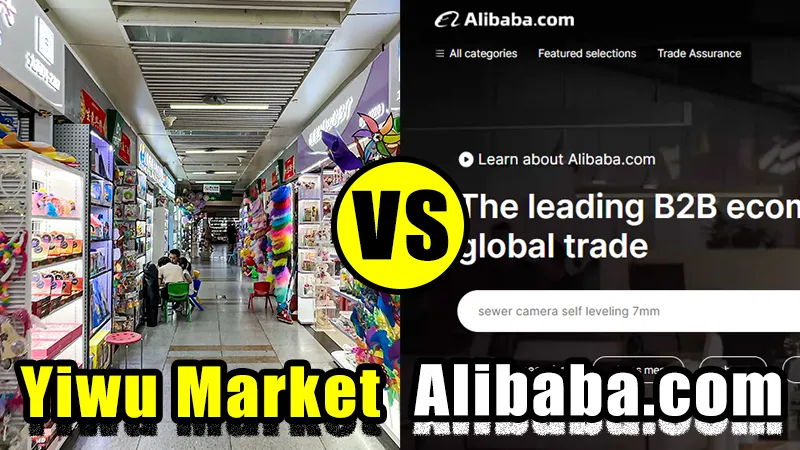
Yiwu Market, located in Zhejiang Province, China, is the world’s largest physical wholesale market. Spanning over 5.5 million square meters, it houses more than 75,000 booths. Here, suppliers showcase a vast range of small commodities, from toys and jewelry to clothing and home goods. Known as the Yiwu International Trade City, it attracts over 500,000 buyers annually from around the globe.
Unlike online platforms, Yiwu Market thrives on in-person interaction. Buyers can touch, inspect, and negotiate directly with vendors. For many, this hands-on experience is a major draw. However, visiting requires travel, which adds time and cost to the sourcing process.
What Is Alibaba?
Alibaba, on the other hand, is a digital titan. Launched in 1999 by Jack Ma, it’s a B2B (business-to-business) e-commerce platform connecting buyers with suppliers worldwide. Based in Hangzhou, China, Alibaba boasts millions of products across countless categories. From raw materials to finished goods, it’s a one-stop shop for bulk sourcing.
The platform’s strength lies in its convenience. You can browse, negotiate, and order from anywhere with an internet connection. Alibaba also offers tools like supplier verification and secure payment options, making it a go-to for international buyers. However, it often requires higher minimum order quantities (MOQs), which may not suit every business.
Yiwu Market vs Alibaba: A Side-by-Side Comparison
To understand which platform suits your needs, let’s break down the key differences between Yiwu Market vs Alibaba. This comparison covers cost, product variety, MOQs, accessibility, and more.
Cost Comparison
Yiwu Market: Prices at Yiwu are often lower for small batches because you’re buying directly from wholesalers. For example, a single carton of toys might cost less than $50. However, travel expenses—flights, hotels, and local transport—can easily exceed $1,000 per trip. If you’re sourcing small quantities, these costs might outweigh the savings.
Alibaba: Alibaba’s pricing varies widely. Suppliers set their own rates, often higher per unit than Yiwu due to shipping and platform fees. However, for bulk orders, Alibaba shines. A large order of electronics, for instance, could drop unit costs significantly. The catch? You’ll need to factor in international shipping, which can add hundreds or thousands of dollars.
Verdict: Yiwu Market wins for small, affordable orders if you’re nearby or can visit. Alibaba is more cost-effective for large-scale sourcing without travel.
Product Variety
Yiwu Market: Yiwu specializes in small commodities. Think accessories, decorations, and everyday items. With over 2,000 product categories, it’s a treasure trove for niche goods. However, it lacks heavy machinery or highly specialized industrial products.
Alibaba: Alibaba’s range is unmatched. It covers everything from consumer goods to industrial equipment. Whether you need 1,000 LED lights or a custom-built machine, Alibaba has suppliers for it. This breadth makes it ideal for businesses with diverse needs.
Verdict: For niche, small items, Yiwu Market is king. For broader variety, Alibaba takes the lead.
Minimum Order Quantities (MOQs)
Yiwu Market: MOQs at Yiwu are typically low—often one or two cartons (50-200 units). Suppliers are flexible, especially if you negotiate in person. This makes it perfect for small businesses or those testing new products.
Alibaba: Alibaba’s MOQs are higher, often starting at 500 or 1,000 units. Suppliers cater to big volume buyers, which can be a hurdle for small-medium. Some offer lower MOQs, but prices rise accordingly. Additionaly, the suppliers on Alibaba communicate with you virtually, this could be hard to build trust through screen.
Verdict: Yiwu Market is better for low MOQs and building trust. Alibaba suits big volume buyers.
Accessibility and Convenience
Yiwu Market: Visiting Yiwu requires effort. You’ll need a visa, flights, and time to navigate the sprawling market. Language barriers can also complicate negotiations unless you partner with a local Yiwu agent. Still, the tactile experience is invaluable for quality checks.
Alibaba: Alibaba is accessible 24/7 from your laptop. Its English interface and multilingual support ease communication. However, you’re relying on photos, reviews, and supplier promises—quality isn’t guaranteed.
Verdict: Alibaba wins for convenience. Yiwu Market excels for hands-on buyers.
Pros and Cons of Yiwu Market
Pros
- Low Prices for Small Orders: Direct buying cuts out middlemen, reducing costs.
- Hands-On Quality Checks: You can inspect goods before committing.
- Flexible Negotiations: Face-to-face talks often yield better deals and MOQs.
Cons
- Travel Costs: Getting to Yiwu isn’t cheap or quick.
- Time-Intensive: Exploring the market takes days, not hours.
- Logistics Complexity: Shipping arrangements fall on you, the best way that many buyers do is to partner with a Yiwu agent with one-stop service.
Pros and Cons of Alibaba
Pros
- Global Reach: Source from anywhere without leaving home.
- Massive Selection: Millions of products at your fingertips.
- Buyer Protections: Tools like Trade Assurance reduce scam risks.
Cons
- Higher MOQs: Not ideal for small batches.
- Shipping Costs: International fees can pile up.
- Quality Risks: You can’t touch products before buying.
When to Choose Yiwu Market
Yiwu Market shines in specific scenarios. For instance, if you’re sourcing unique, low-cost items like holiday decorations or fashion accessories, Yiwu is unbeatable. Its low MOQs also suit small businesses or those testing the market. Plus, if you’re already in China, reaching Yiwu is quite easy, the direct interaction with suppliers is a game-changer.
Consider this: A retailer needing 200 custom keychains might pay $0.50 each at Yiwu, totaling $100. On Alibaba, the same order could require a 1000-unit MOQ at $0.70 each, costing $700 plus shipping. Clearly, Yiwu saves money here.
When to Choose Alibaba
Alibaba is the better choice for bulk sourcing or businesses with no travel budget. If you need 10,000 phone cases or industrial parts, Alibaba’s scale and supplier network deliver. Its digital platform also saves time, letting you compare dozens of quotes in hours.
For example, a dropshipper ordering 1,000 units of a gadget might pay $2 each on Alibaba, totaling $2,000 with shipping. At Yiwu, the same order could cost less per unit but require a $1,500 trip, pushing expenses higher.
How to Maximize Your Experience
Tips for Yiwu Market
- Hire an Agent: A professional Yiwu agent simplifies not only navigation and translation, but also providing market guide, order tracking, inspection, warehousing, container loading and shipping.
- Plan Ahead: Research districts (e.g., District 1 for toys) to save time.
- Negotiate Smartly: Bring cash and be ready to haggle.
Tips for Alibaba
- Vet Suppliers: Look for Gold Supplier badges and high ratings.
- Request Samples: Test quality before bulk orders.
- Use Trade Assurance: Protect your payment against fraud. Although many customers still get scammed on alibaba, still, try to use trade assurance to reduce risk.
Yiwu Market vs Alibaba: Real-World Examples
Let’s look at two scenarios to clarify the Yiwu Market vs Alibaba debate.
Scenario 1: Small Retailer
A boutique owner needs 100 pairs of earrings. At Yiwu, they visit, negotiate, and pay $1 per pair—$100 total. Travel costs $1,200, so the total is $1,300. On Alibaba, the MOQ is 1000 pairs at $1.50 each ($1500) plus $350 shipping—$1850 in total. In most cases, customers come visit Yiwu not only for few items, they buy mix items to reach a whole container to save a lot cost.
Scenario 2: E-Commerce Seller
An online store needs 5,000 phone chargers. Yiwu offers $0.80 each ($4,000) but requires a trip ($1,500) and shipping ($800)—$6,300 total. Alibaba quotes $1.50 each ($4,500) with $700 shipping—$7,450 total. Yiwu is cheaper and easier here.
The Hybrid Approach: Combining Both
Why choose one when you can use both? Some businesses visit Yiwu to build supplier relationships, then order through Alibaba for convenience. For instance, you might source samples in Yiwu, then scale up via Alibaba. This hybrid strategy leverages Yiwu’s tactile benefits and Alibaba’s efficiency.
Final Thoughts: Yiwu Market vs Alibaba
| Factor | Yiwu Market | Alibaba |
| Product Variety | ✔️ Best for stock & customized products | ✔️ Best for custom manufacturing |
| Pricing | ✔️ Lower & negotiable | ❌ Higher due to platform fees |
| MOQ | ✔️ Small MOQ available | ❌ Often high |
| Quality Control | ✔️ In-person inspection | ❌ Requires third-party check |
| Payment Security | ❌ Risky without having an agent | ✔️ Trade Assurance |
| Shipping | ✔️ Via local Yiwu agent | ✔️ Supplier Direct shipping with big quantity order |
So, which is better in the Yiwu Market vs Alibaba showdown? It depends on your goals. Yiwu Market excels for small, hands-on orders with low MOQs. Alibaba dominates for bulk. Consider your budget, order size, and time constraints.
For small-medium businesses or niche products, Yiwu Market offers unbeatable value if you can visit. For scalability and convenience, Alibaba is hard to beat. Whichever you pick, plan carefully—success lies in matching the platform to your needs.
Looking for a professional Yiwu agent to simplify importing from the Yiwu market? Visit our homepage to discover expert assistance that makes your sourcing and shipping easier, faster, and more efficient.
Related Articles
Is DHgate Legit in 2025? | Do 1688 supplier buy from Yiwu Market? | Where Is Yiwu Market Located | Yiwu Sourcing Mistakes to Avoid | Yiwu Agent vs Alibaba
Popular Articles
Yiwu Market District 1 | Yiwu Market District 2 F Section | Yiwu Market District 2 G Section | Yiwu Market District 3 | Yiwu Market District 4 | Yiwu Market District 5 | Yiwu Market Products | Yiwu Market Map | Yiwu Market Process | How to reach Yiwu | Why You An Agent to Import from Yiwu Market | Types of Suppliers in Yiwu Market
Follow Our Social Media: Youtube | Facebook | Instagram | LinkedIn | Pinterest | TikTok | Threads | Twitter | Reddit