
If you import products from China, learning how to spot fake factory videos has become more important than ever. Today, many suppliers use polished factory walkthrough videos to attract overseas buyers. However, some videos are heavily edited, borrowed from other factories, created with AI tools, or completely unrelated to the real supplier. As a result, many importers mistakenly trust suppliers that do not actually own factories or lack real production capability.
Fortunately, there are practical ways to verify whether a factory video is real. By checking production details, employee activity, editing patterns, and supplier information, buyers can reduce sourcing risks significantly. Moreover, understanding these warning signs can help protect your business from scams, low-quality products, and failed shipments.
Why Fake Factory Videos Are Increasing
In recent years, video marketing has become one of the most common tools used by suppliers. Since international buyers often cannot visit China personally, many suppliers rely on videos to build trust quickly.
However, modern editing software and AI tools now make it easier to create convincing factory content. Consequently, some dishonest suppliers use fake videos to appear larger, more professional, or more experienced than they actually are.
Additionally, many trading companies pretend to be direct factories because buyers usually prefer purchasing from manufacturers. Therefore, fake factory videos have become a growing issue in global sourcing.
How to Spot Fake Factory Videos Using Simple Checks
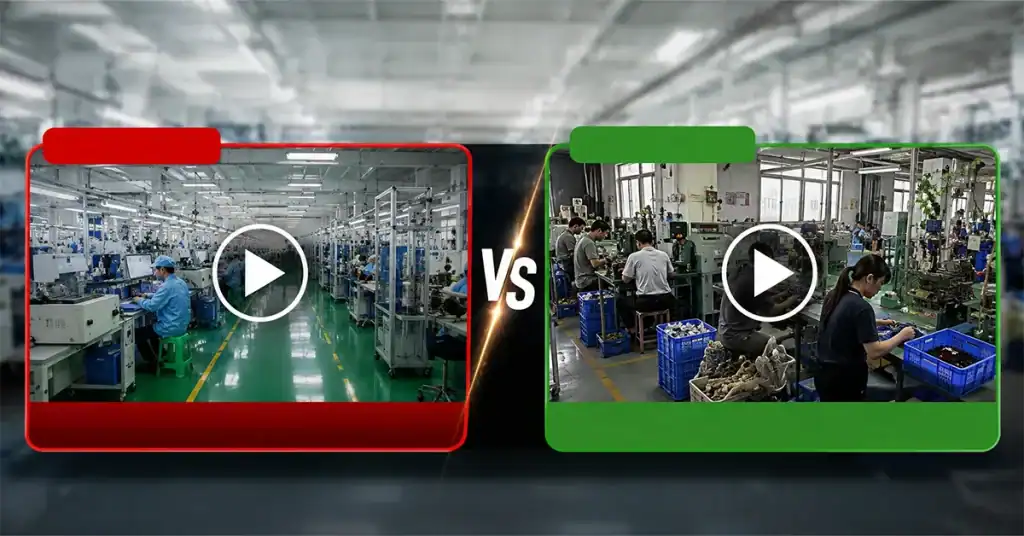
The easiest way to understand how to spot fake factory videos is to focus on consistency and authenticity. Real factories usually show natural production environments, while fake videos often contain unusual patterns or unrealistic scenes.
Watch for Overly Perfect Production Lines
Real factories are usually busy and slightly messy. Workers move naturally, products stack unevenly, and production areas contain normal operational activity.
In contrast, fake factory videos often look too perfect. For example, production lines may appear extremely clean, workers may move unnaturally, or machinery may not actually operate during filming.
Additionally, some videos repeat the same camera angles several times to create the illusion of a larger factory.
Check Whether Workers Are Actually Working
Another important tip for how to spot fake factory videos is observing employee behavior carefully.
In genuine factories:
- Workers focus on tasks naturally
- Machines produce real operational sounds
- Products move through different production stages
- Employees wear consistent uniforms or safety equipment
However, fake videos sometimes show workers pretending to work without real production activity. Moreover, some workers may look directly into the camera repeatedly because they are staged for filming.
Look for Suspicious Editing Cuts
Heavy editing can hide important details. Therefore, buyers should pay attention to excessive transitions, fast cuts, dramatic music, or repeated scenes.
If the video constantly changes angles every few seconds, the supplier may be trying to avoid showing the full production environment clearly.
Furthermore, some fake factory videos combine footage from multiple unrelated locations to appear larger.
How AI Technology Is Changing Supplier Videos
AI-generated content is becoming more advanced every year. Consequently, understanding how to spot fake factory videos now also involves identifying AI-related warning signs.
AI Voiceovers and Artificial Narration
Some suppliers now use AI-generated voiceovers instead of real staff introductions. Although AI narration itself is not necessarily suspicious, problems appear when suppliers avoid showing real management or real communication.
If the video contains robotic narration but no genuine employee interaction, buyers should investigate further.
Unrealistic Lighting and Motion
AI-generated footage may contain unnatural lighting, distorted hands, inconsistent shadows, or unusual machine movement.
Additionally, AI videos sometimes create unrealistic factory layouts that do not match normal manufacturing operations.
Therefore, buyers should pause videos carefully and inspect small visual details.
Fake Factory Drone Footage
Some suppliers use stock drone footage from unrelated industrial parks. As a result, buyers may incorrectly assume the buildings belong to the supplier.
Fortunately, this issue can often be detected by comparing company addresses with satellite maps and business registration information.
How to Verify Whether a Factory Is Real
Besides learning how to spot fake factory videos, buyers should also verify suppliers using additional methods.
Request a Live Video Call
One of the best verification methods is requesting a live factory video call.
During the call, ask the supplier to:
- Walk through the factory continuously
- Show warehouse inventory
- Display production lines in real time
- Introduce managers or supervisors
- Show company signage clearly
Since live video calls are harder to manipulate, they provide much stronger verification.
Check Business Licenses Carefully
Always ask suppliers for their Chinese business license.
Then verify:
- Company name
- Business scope
- Registered capital
- Operating status
- Factory address
Additionally, compare the address shown in the license with the address shown in videos and online maps.
Use Third-Party Factory Inspections
Third-party inspections remain one of the safest sourcing methods. Inspection companies can physically visit suppliers and confirm whether production facilities are genuine.
Moreover, inspections help buyers verify product quality, factory scale, and operational capability before large payments are made.
You can also read our Verify Yiwu Supplier Guide for additional supplier verification methods.
Common Signs of Fake China Suppliers
Understanding supplier behavior is another important part of learning how to spot fake factory videos.
Extremely Low Prices
If pricing looks far below market average, buyers should become cautious immediately.
Although competitive pricing is normal in China, unrealistically cheap pricing often signals hidden problems.
Refusal to Show Live Production
Some suppliers avoid live video calls completely. Instead, they repeatedly send edited videos only.
This behavior should raise concerns because real factories usually have no problem showing production activity directly.
Unclear Company Identity
Some fake suppliers use different company names across websites, Alibaba profiles, invoices, and videos.
Therefore, buyers should always confirm that all business information matches consistently.
How Real Factories Usually Present Themselves
Real factories usually focus more on operational details than dramatic marketing.
For example, genuine suppliers often show:
- Raw materials
- Quality inspection processes
- Packaging operations
- Warehouse management
- Production scheduling
- Employee coordination
Additionally, real factories normally answer technical questions clearly because they understand production deeply.
How Trading Companies Use Factory Videos
Not all trading companies are dishonest. In fact, many professional trading companies work closely with reliable factories.
However, problems occur when trading companies pretend to own factories they do not actually control.
Therefore, buyers should understand the supplier structure clearly before placing large orders.
Sometimes, working with a professional sourcing company can actually reduce risks because sourcing agents already verify factories regularly.
You can also read our China Sourcing Agent Guide to understand how sourcing support works.
How Social Media Makes Fake Factory Videos Spread Faster
Platforms like TikTok, YouTube, LinkedIn, and Instagram now allow supplier videos to spread quickly worldwide.
Unfortunately, viral content often creates false trust signals.
For example, buyers may assume:
- high views equal credibility
- professional editing equals real manufacturing
- large buildings equal ownership
- English-speaking presenters equal reliability
However, social media popularity does not guarantee supplier legitimacy.
Therefore, buyers should combine video analysis with proper supplier verification procedures.
Best Practices to Avoid Supplier Scams
Learning how to spot fake factory videos is only one part of safe sourcing. Buyers should also follow broader risk-control practices.
Start with Small Orders
Instead of placing large orders immediately, begin with smaller test orders first.
This approach helps evaluate communication, production quality, and shipping reliability.
Use Secure Payment Methods
Avoid sending full payment upfront to unknown suppliers.
Instead, use safer payment structures whenever possible.
Document Everything Clearly
Keep written agreements for:
- product specifications
- quality standards
- delivery schedules
- payment terms
- packaging requirements
Clear documentation reduces misunderstandings later.
Final Thoughts on How to Spot Fake Factory Videos
As AI tools and video editing technology continue improving, learning how to spot fake factory videos is becoming an essential skill for international buyers.
Fortunately, buyers can still verify suppliers successfully by focusing on consistency, live verification, business records, inspections, and realistic production behavior.
Moreover, experienced importers understand that trust should never depend only on polished videos or attractive marketing content.
Instead, safe sourcing requires careful verification, professional communication, and proper supplier evaluation.
Ultimately, buyers who take time to verify suppliers carefully can reduce scams, improve product quality, and build stronger long-term sourcing relationships in China.
Planning to source products from Yiwu Market? Our professional Yiwu sourcing team helps international buyers with airport pickup, Yiwu market guidance, supplier negotiation, order tracking, product inspection, warehousing, container loading, China customs, and international shipping.
👉 Learn more about our Yiwu Agent services or contact us to get a free sourcing consultation.
Related Articles:
Why You Need a Yiwu Agent | Sourcing Cases | Shipping Cases
Where Is Yiwu Market Located | How to fly to Yiwu | Yiwu Hotels | Yiwu Restaurants | Yiwu Market Full Guide | Why Yiwu Is Famous | Yiwu Market Secrets | Yiwu Market Buying Tips | How to Apply Chinese Visa
What’s the MOQ in Yiwu Market? | Yiwu Market Product List | Yiwu Market Price List | Top 10 Mistakes to Avoid in Yiwu Market | Top 10 Popular Products in Yiwu Market | Best Time to Import from Yiwu Market | Is It Safe to Import From Yiwu Market | Yiwu Market History
Popular Articles:
Yiwu Market District 1 | Yiwu Market District 2 F Section | Yiwu Market District 2 G Section | Yiwu Market District 3 | Yiwu Market District 4 | Yiwu Market District 5 | Yiwu Market New District 6
Yiwu Market Products | Yiwu Market Map | Yiwu Market Process | Warehousing & Quality Control | Feature | FAQ
Follow Our Social Media:
Youtube | Facebook | Instagram | LinkedIn | Pinterest | TikTok | Threads | Twitter | Reddit