
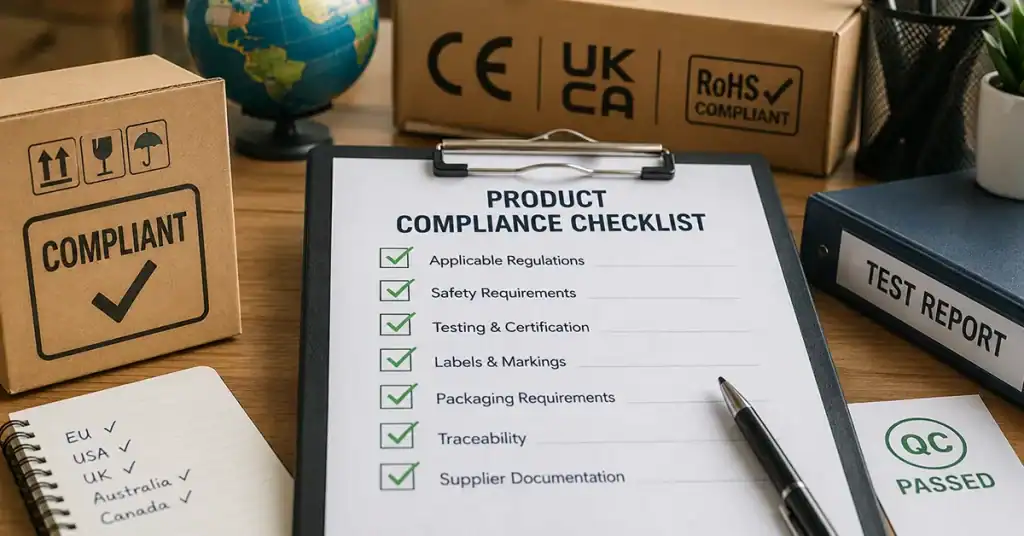
A Yiwu product compliance checklist should confirm the rules for your destination market, required testing, product labels, packaging, traceability and supplier evidence before you select a factory. Do not rely on a CE mark, test-report cover page or verbal promise alone. Instead, match every document to the exact product, model, materials and factory that will produce your order.
This early review protects you from failed customs clearance, marketplace restrictions, recalls and costly product changes. Moreover, it helps you reject unsuitable suppliers before you spend money on samples, packaging design or deposits.
What the Yiwu Product Compliance Checklist Covers
Product compliance means meeting the legal, safety, technical, labelling and documentation rules in the country where you will sell the goods. However, the exact requirements depend on the product, intended user and destination market.
For example, a decorative storage box has different requirements from a children’s toy, wireless device or food-contact container. Therefore, use this Yiwu product compliance checklist for the exact product you intend to import—not merely for a similar item shown in a supplier’s catalogue.
- Product category and intended use
- Age group and target customer
- Destination country and sales channel
- Applicable laws and technical standards
- Required laboratory tests and certificates
- Product, packaging and instruction labels
- Material and component restrictions
- Batch numbers and traceability records
- Factory quality-control capability
Rules can change, and one product may fall under several regulations. Consequently, confirm the final requirements with the relevant authority, an accredited laboratory or a qualified compliance specialist.
Step 1: Define the Product Before Checking Compliance
First, create a written product specification. A vague request such as “silicone kitchen product” is not enough because the item’s use, material and construction can change which rules apply.
- Describe the intended use. State who will use the product, how it will be used and whether it touches food, skin or children.
- List every material. Include coatings, ink, glue, batteries, cables, metal parts and packaging materials.
- Fix the design. Record dimensions, power ratings, components, colours and model numbers.
- Name the destination market. The United States, European Union, United Kingdom and other markets have different rules.
- Confirm the sales channel. Amazon, retailers and distributors may impose extra document or test requirements.
Furthermore, freeze the specification before testing. If the supplier later changes the paint, plastic resin, battery or electronic board, the original report may no longer support the finished product.
Step 2: Map the Rules for Your Destination Market
Next, identify every rule that applies to the product. Avoid asking only, “Do you have CE?” CE marking applies only to product groups covered by specific European Union legislation. In addition, the manufacturer must identify the relevant requirements, complete the correct assessment and prepare supporting technical documents.
The European Union’s official CE marking guidance also warns that voluntary certificates may not be legally valid for CE marking. Therefore, a colourful certificate from an unknown company is not proof by itself.
Likewise, US importers may carry direct certification duties. For example, the US Consumer Product Safety Commission explains that importers of covered general-use products may need a General Certificate of Conformity based on testing or a reasonable testing program.
| Product Type | Possible Compliance Areas | Evidence to Check |
|---|---|---|
| Children’s toys | Mechanical safety, chemicals, age grading and tracking labels | Relevant test reports, material records and label artwork |
| Electrical products | Electrical safety, EMC, energy use and restricted substances | Model-specific reports, component list and declarations |
| Wireless devices | Radio frequency and equipment authorization | Authorization records, model identity and technical reports |
| Food-contact items | Material migration and food-contact safety | Material-specific reports and supplier declarations |
| Textiles | Fibre content, care labels, flammability and chemicals | Fabric reports, label files and production specifications |
This table is a starting point, not legal advice. Nevertheless, it shows why compliance must be mapped before supplier selection.
Step 3: Verify the Supplier’s Compliance Evidence
Once you know the requirements, ask each supplier for complete evidence. Then compare the report details with your product specification.
A useful Yiwu product compliance checklist should verify:
- The applicant and manufacturer names
- The factory address
- The tested product name and model number
- Photos of the tested sample
- Materials and components covered by the test
- Standards and test methods used
- Issue date and report validity
- Laboratory name and accreditation scope
- Final results, including any failures or limits
For instance, a supplier may show a passing report for a basic USB lamp while offering you a lamp with a different adapter, battery and wireless feature. Although the products look similar, the old report may not cover your model.
You should also compare suppliers beyond unit price. This guide to comparing Yiwu product suppliers explains how to assess capability, communication, quality and commercial risk together.
Check Whether the Report Can Be Verified
Ask for the complete report rather than one certificate page. Afterward, contact the laboratory or use its online verification system when available. Also confirm that the laboratory was allowed to test the relevant standard.
If the supplier refuses to provide supporting pages, gives unclear answers or sends documents for another factory, treat that as a warning. A supplier’s confidence is helpful, but traceable evidence is better.
Step 4: Check Labels, Packaging and Instructions
Compliance does not stop with laboratory testing. Your product may also need model identification, warnings, importer details, country-of-origin marking, batch information and instructions in the correct language.
Therefore, approve the label and packaging artwork before mass production. In addition, place every requirement in the purchase order so the factory cannot treat it as an optional request.
For EU sales, importers may need to verify technical documents, labels, traceability and safety instructions before placing products on the market. The official EU product compliance guidance describes these importer duties.
Meanwhile, US children’s products may require permanent tracking information on both the product and packaging where practical. As a result, leaving label design until after production can cause expensive rework.
How to Compare Yiwu Suppliers for Compliance Readiness
A capable supplier should understand the product, control its materials and explain which documents support each model. By contrast, a weak supplier often sends unrelated reports and promises to “add the mark” after you order.
| Check | Lower-Risk Supplier | Higher-Risk Supplier |
|---|---|---|
| Documents | Provides complete, matching and verifiable reports | Sends cropped certificates for similar products |
| Materials | Can identify and control key materials | Changes materials according to price or availability |
| Production | Uses written specifications and batch records | Relies mainly on verbal instructions |
| Testing | Accepts model-specific testing when required | Claims one report covers every model |
| Quality control | Welcomes inspection against an agreed checklist | Discourages independent checks |
Before visiting or ordering, review these checks before buying in Yiwu Market. Moreover, consider a factory or warehouse inspection when documents, materials or production control need closer review. Goldenshiny can help with sourcing, warehousing and inspection in China.
Need Help Checking a Product Before You Order?
Goldenshiny Trading can review your product brief, supplier options, MOQ, compliance evidence, target cost and shipping plan. Therefore, you can identify major risks before paying a deposit or committing to custom packaging.
Step 5: Test the Correct Sample and Inspect Production
After selecting a suitable supplier, order a sample made to your final specification. Then confirm whether testing must cover the complete product, selected materials or both.
Do not let the supplier send a “special testing sample” that differs from normal production. Instead, record the sample’s model, materials and components. Later, use those details during production inspection.
A practical process is:
- Approve the written specification and bill of materials.
- Approve the final sample and packaging artwork.
- Arrange required laboratory testing.
- Add compliance terms to the purchase order.
- Inspect materials and workmanship during production.
- Check labels, quantities and cartons before shipment.
- Keep reports, invoices, batch records and inspection files.
Because product quality and compliance overlap, read these methods for avoiding low-quality Yiwu products. You can also use a pre-shipment cargo inspection to catch visible differences before the goods leave China.
Yiwu Product Compliance Checklist: Go or No-Go Decision
Before selecting the supplier, answer each question with “yes” and keep the evidence:
- Is the product specification complete?
- Have you confirmed the rules for the destination market?
- Do the reports match the exact model and factory?
- Can the laboratory and report be verified?
- Are all labels, warnings and instructions defined?
- Can the supplier control materials and components?
- Will your final sample represent mass production?
- Are compliance terms written into the order?
- Is inspection planned before shipment?
- Does the landed cost still support your target margin?
If several answers are “no,” pause the order. Although changing suppliers may delay the project, importing a non-compliant product can cost far more. Also calculate testing, inspection, packaging and possible duty within your Yiwu landed cost.
Get a Yiwu Product Feasibility Review
If you have a product idea but are unsure which supplier can meet your requirements, Goldenshiny Trading can compare factories, collect documents, arrange samples and coordinate inspections. A structured review gives you a clearer go-or-no-go decision before production begins.
Frequently Asked Questions
Can I rely on a supplier’s CE certificate?
No. First confirm whether CE marking applies. Then verify that the report, technical documents and declaration cover the exact product, model, materials and manufacturer. A certificate page alone is not enough.
Who is responsible for imported product compliance?
Responsibility depends on the market and product. However, importers and private-label sellers often carry direct duties. Therefore, never assume the Chinese supplier accepts all legal responsibility.
Should I test a product before choosing the supplier?
First screen the supplier’s existing evidence and production capability. Then select a suitable supplier and test a final-specification sample before mass production when required.
What if the supplier changes a material after testing?
Stop and assess the change. A new material, component or production method can affect safety and compliance. Consequently, you may need updated documents or additional testing.
Can a Yiwu sourcing agent guarantee product compliance?
A sourcing agent can help collect documents, confirm specifications, coordinate laboratories and inspect production. However, final legal responsibility remains with the responsible business under the destination market’s rules.
Final Advice Before Selecting a Yiwu Supplier
The safest supplier is not simply the one with the lowest quotation or the largest folder of certificates. Instead, choose a supplier that can connect every claim to the exact product, materials, factory and production process.
Use the Yiwu product compliance checklist before paying a deposit. Then repeat key checks when the sample, materials, packaging or regulations change. This disciplined approach reduces surprises and gives your product a stronger path from Yiwu factory to its final market.
If you need local support, Goldenshiny Trading can help you evaluate and work with a reliable China sourcing agent while coordinating suppliers, samples, quality checks, consolidation and shipping.
Planning to source products from Yiwu Market? Our professional Yiwu sourcing team helps international buyers with airport pickup, Yiwu market guidance, supplier negotiation, order tracking, product inspection, warehousing, container loading, China customs, and international shipping.
👉 Learn more about our Yiwu Agent services or contact us to get a free sourcing consultation.
Related Articles:
Why You Need a Yiwu Agent | Sourcing Cases | Shipping Cases
Where Is Yiwu Market Located | How to fly to Yiwu | Yiwu Hotels | Yiwu Restaurants | Yiwu Market Full Guide | Why Yiwu Is Famous | Yiwu Market Secrets | Yiwu Market Buying Tips | How to Apply Chinese Visa
What’s the MOQ in Yiwu Market? | Yiwu Market Product List | Yiwu Market Price List | Top 10 Mistakes to Avoid in Yiwu Market | Top 10 Popular Products in Yiwu Market | Best Time to Import from Yiwu Market | Is It Safe to Import From Yiwu Market | Yiwu Market History
Popular Articles:
Yiwu Market District 1 | Yiwu Market District 2 F Section | Yiwu Market District 2 G Section | Yiwu Market District 3 | Yiwu Market District 4 | Yiwu Market District 5 | Yiwu Market New District 6
Yiwu Market Products | Yiwu Market Map | Yiwu Market Process | Warehousing & Quality Control | Feature | FAQ
Follow Our Social Media:
Youtube | Facebook | Instagram | LinkedIn | Pinterest | TikTok | Threads | Twitter | Reddit